
Scaling Proven Elevator Safety to Extreme Industrial Applications
Background
Traditional lift safety systems rely on VG (Variable Geometry) safety gears, a well-established and highly reliable technology used in lift shafts worldwide. These systems typically:
- Weigh less than 25 kg
- Operate on 16 mm guide rails
- Function in controlled, low-contamination environments
- Are activated via a conventional friction Overspeed Governor (OSG)
However, emerging industrial applications—such as heavy vertical transport systems, mining shafts, offshore lifting platforms, and extreme-environment hoisting—demand orders-of-magnitude increases in mass, braking force, and environmental resilience.
The Challenge
The Colossus project set out to answer a difficult engineering question:
Can a conventional VG safety gear design be scaled up nearly 50× in mass and still retain reliability, controllability, and compatibility with standard activation systems?
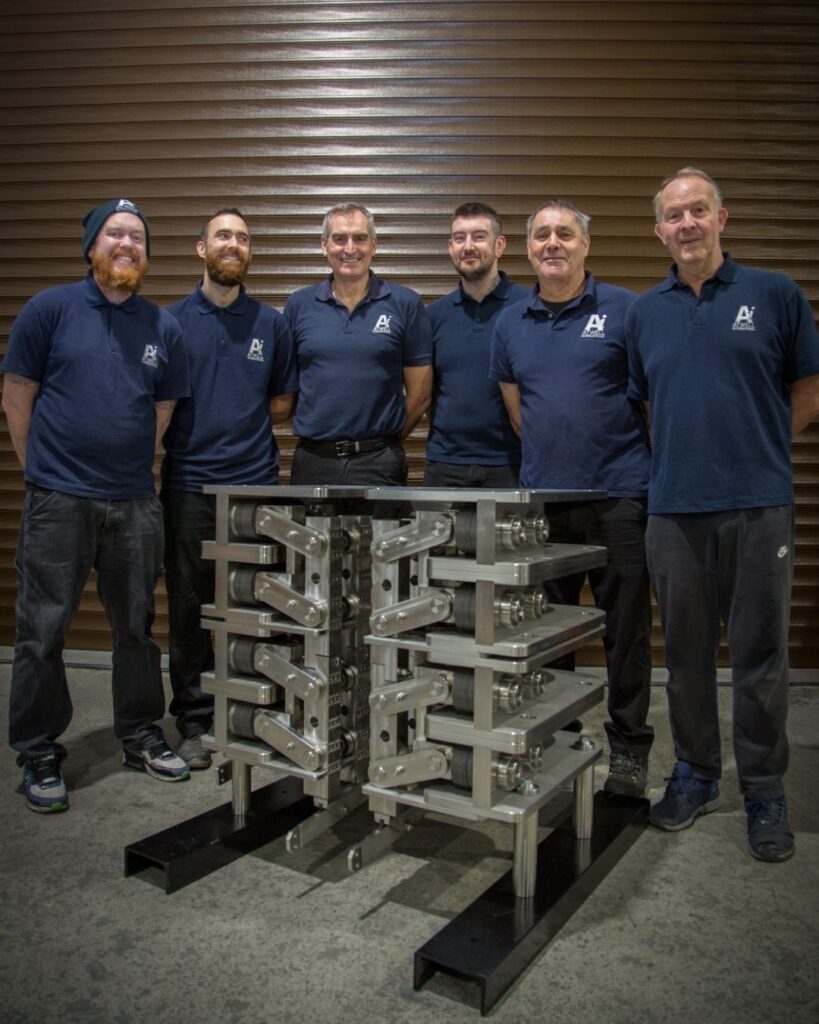
Key requirements included:
- System mass increase: from ~25 kg → 1200 kg
- Guide rail scaling: from 16 mm → 100 mm blade
- Extreme operating environments: Dust, water ingress, and debris, temperature extremes, corrosive atmospheres
- High-energy braking scenarios far exceeding typical lift conditions
- Retention of conventional friction-type OSG activation
Engineering Approach
Rather than reinventing the safety gear concept, the design philosophy was:
“Scale the proven, not replace it.”
Core Design Principles
- Maintain VG geometry and wedge-based braking mechanics
- Preserve progressive braking characteristics
- Use mechanical amplification rather than complexity
- Ensure predictable behavior under extreme loads
Structural Scaling
Scaling wasn’t linear—it required addressing:
- Material stress limits
- Heat dissipation during braking
- Surface contact pressures
- Elastic deformation at large loads
Key adaptations:
- Reinforced housing and wedge components using high-strength alloy steels
- Enlarged contact surfaces to distribute load across the 100 mm rail
- Precision-machined guide interfaces to maintain alignment under load
- Integration of thermal mass and dissipation paths to manage braking heat
Braking Mechanics
Despite its size, Colossus retains the fundamental VG safety gear behavior:
- OSG detects overspeed
- Governor rope activates linkage
- Wedge mechanism engages rail
- Progressive braking force increases with load
What changes at Colossus scale:
- Braking forces are exponentially higher
- Energy absorption becomes a primary design driver
- Micro-tolerances become macro-critical
Overspeed Governor Integration
One of the most notable achievements is that the Colossus system:
- Operates using a standard friction-type OSG
- Requires no fundamentally new control philosophy
- Maintains fail-safe mechanical actuation
Engineering considerations included:
- Ensuring sufficient trigger force transmission over larger distances
- Managing rope dynamics under harsher conditions
- Preventing false activation in vibration-heavy environments
Environmental Adaptation
Unlike conventional lift shafts, Colossus operates in environments that are:
- Abrasive (dust, particulates)
- Wet or submerged
- Thermally unstable
- Chemically aggressive
Design responses:
- Sealed or shielded critical moving interfaces
- Use of corrosion-resistant coatings and materials
- Tolerances designed to function despite contamination
- Reduced reliance on fine lubrication regimes
Key Outcomes
- Successfully scaled VG safety gear from 25 kg → 1200 kg
- Maintained core mechanical simplicity
- Preserved compatibility with standard OSG systems
- Delivered reliable operation in extreme industrial environments
Testing & Validation
Testing focused on:
- Full-load emergency stops
- Repeated high-energy braking cycles
- Operation under contaminated conditions
- Performance across temperature extremes
Results demonstrated:
- Consistent, controlled deceleration
- No catastrophic wear or deformation
- Reliable activation via conventional OSG
- Predictable performance across all test scenarios
Lessons Learned
- Proven designs scale better than new concepts when properly engineered
- Geometry matters more than complexity in safety-critical systems
- Environmental robustness must be designed in, not added later
- Maintaining compatibility (e.g., with OSG systems) dramatically reduces system risk
Conclusion
The Colossus Safety Gear demonstrates that robust, time-tested mechanical principles can be successfully extended into entirely new operational domains.
By scaling the VG safety gear concept rather than replacing it, the system achieves:
- Massive increases in capacity
- High reliability
- Operational familiarity
All while functioning in conditions far beyond the scope of traditional lift systems.